- Home
- About
- Our services
A web-based urban forest management tool, which enables users to schedule and track work orders and manage their tree population on a day-to-day basis.
- Case Studies
- Resources
- Events
- Contact
Hartlepool’s industrial heritage and coastal location have shaped the town’s landscape over many decades. Whilst these have contributed strongly to local identity, they have also resulted in one of the lowest levels of urban tree cover in the country.
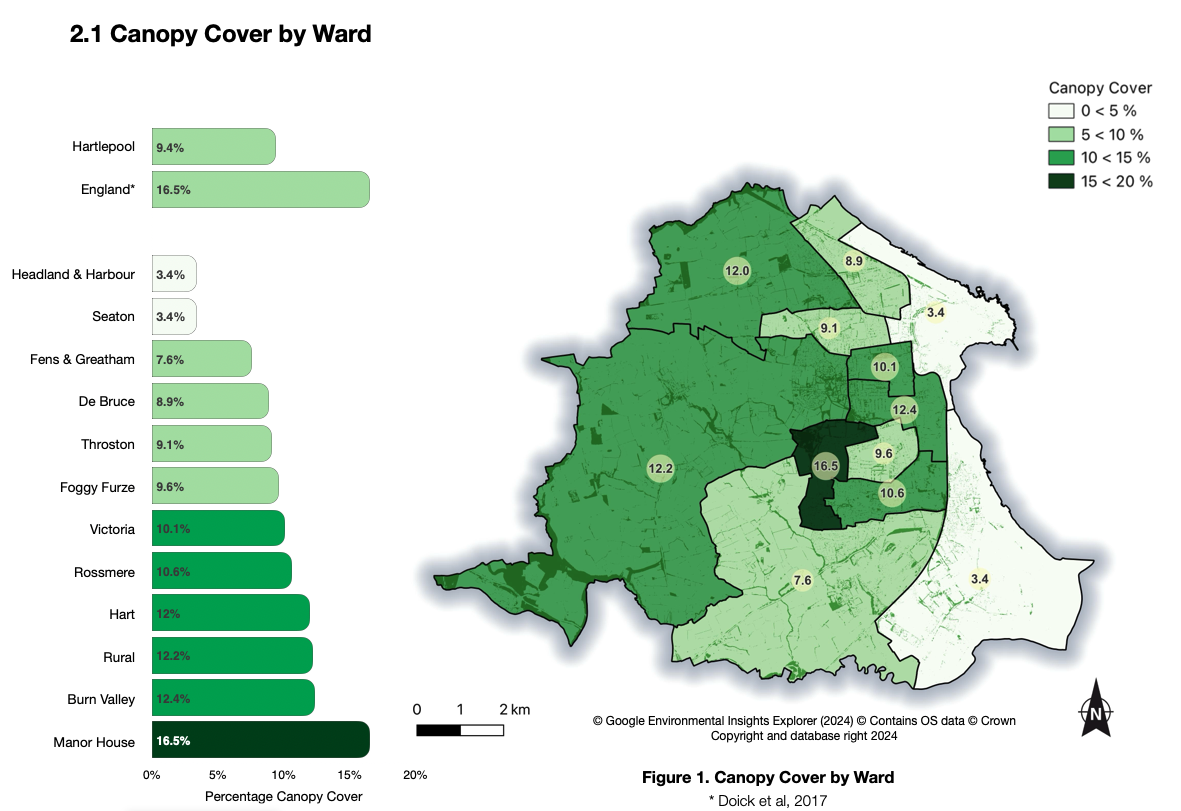
Hartlepool’s tree canopy cover is approximately 9.4%, significantly below Forest Research’s recommended minimum of 15% for coastal towns. Some neighbourhoods have canopy cover as low as 2% – and its tree equity score is the second lowest in England.
However, Hartlepool’s existing trees and woodlands are already delivering huge value. They are storing approximately 70,900 tonnes of carbon, worth around £71 million, and delivering ecosystem services valued at approximately £3.5 million per year. Having baseline data like this typically makes it easier for councils to invest in the protection of trees and the establishment of new ones.
The challenge for Hartlepool was how to make access to green space more equitable.
The first step was identifying where new trees could realistically be planted, and this is where Treeconomics stepped in with a comprehensive Tree Planting Opportunity Map. This map identified where trees could realistically be planted across both soft landscapes (such as parks, grass verges and open spaces) and hard landscapes (including streets and pavements). Unsuitable areas, such as buildings, transport infrastructure, protected sites and existing tree canopy, were left out.
The results showed:
In hard landscapes, the map highlighted locations suitable for engineered solutions such as tree pits and kerb build-outs, recognising that street trees often deliver some of the greatest benefits because they are planted closest to where people live and work.
Alongside this mapping, Trees for Cities ran a borough-wide survey, asking residents for their views on trees. The response rate was impressive, around three times the typical response rate for consultations of this kind! 74% of residents felt that trees were not distributed equally. However, 97% of people agreed that trees, woodland and hedgerows were important for Hartlepool. The survey generated more than 1,000 individual location suggestions from residents, identifying where they would like to see new trees planted. Treeconomics were then able to take this data and add it to the map, creating a “desire layer”.
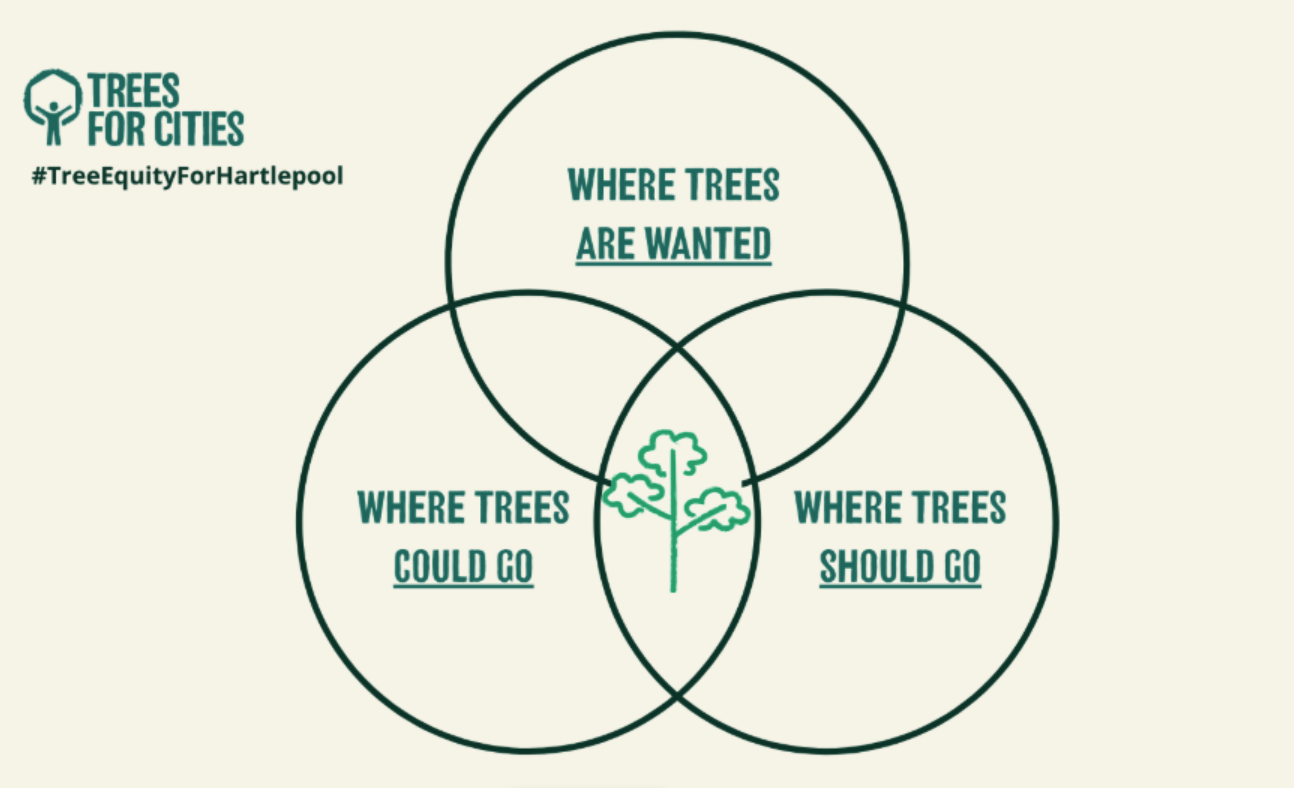
We now had data on where trees could go, based on the mapped actual plantable space; the Tree Equity Score showing which neighbourhoods were highest priority for planting, in other words, where trees should go; and also where trees were wanted, based on the survey. This data has already inspired a number of successful community tree planting schemes.
Not every project has been successful, however. One site experienced repeated vandalism by local children. This highlighted the need for more involvement with local communities and youth groups – as a result, Hartlepool is looking to work more closely with boxing clubs, youth engagement programmes and young offender services, as well as with residents living near planting sites.
The next phase of work focused on understanding how residents experience trees and green spaces in their everyday lives. The internationally recognised 3-30-300 framework, which measures whether residents can see at least three trees from their home, live in areas with at least 30% tree canopy cover, and are within 300 metres of a high quality public green space, was one of the first steps the council took.
Carried out by Treeconomics, the Urban Forest 3-30-30 assessment provided a detailed picture of environmental equity across Hartlepool, highlighting areas where residents have comparatively limited access to trees and nature. It enabled the Council to identify neighbourhoods where investment could have the greatest impact on health and wellbeing.
Assessing all 42,222 residential buildings across the borough, the study found that 55% of homes could see at least three trees, but only 1.7% met the recommended 30% neighbourhood canopy cover target. Whilst 59% of homes were within 300 metres of a public green space, fewer than 1% met all three criteria.
The 3-30-300 approach has given the Council a clear understanding of where green inequity exists, and will help ensure the project delivers the benefits of trees where they are needed most.
While the first two phases of the Tree Equity for Hartlepool project identified where trees were needed, where they could be planted, and where they were wanted, the Urban Forest Master Plan tackles a much bigger question:
How does Hartlepool create an urban forest that will remain healthy in the long term?
Developed by Hartlepool Borough Council, Treeconomics and Trees for Cities, the Master Plan is about much more than planting trees. It provides a roadmap for the next 25 years, showing how Hartlepool can protect its existing trees, grow its tree canopy further, and make trees a central focus in place-making.
Recognising that successful urban forestry depends on strong leadership, long-term funding, cross-departmental working and community involvement, the Master Plan covers:
What makes Hartlepool’s Master Plan stand out is that it isn’t just about trees. It shows how trees and woodlands can help deliver other priorities, from regenerating neighbourhoods and the waterfront to making the town healthier, greener and more attractive.
It also sets out practical ways to get people involved – for example, expanding the Tree Warden network, tree walks and talks, and celebrating Hartlepool’s most significant trees. And, because a large percentage of Hartlepool’s trees are privately owned, it also advises on giving residents, schools, businesses and major landowners guidance on planting and caring for trees.
Above all, the Plan has Tree Equity at its heart. It recognises that some of Hartlepool’s neighbourhoods may have surprisingly low tree cover, but these areas stand to benefit the most. And where planting large trees isn’t always possible, the Plan explores other ways of greening, including green roofs and living walls.
Developing the Urban Forest Master Plan has been a real collaborative effort. Together, the project partners have done a great deal of consultation, and have worked through multiple drafts, to shape a shared vision for Hartlepool’s urban forest.
The Plan outlines a clear set of actions, and as the first chapter of the Tree Equity for Hartlepool project comes to an end, Trees for Cities is seeking further funding to move the project forwards. One thing that is clear within the Master Plan is that Hartlepool’s community will be involved on an ongoing basis.
Hartlepool is one of the first UK councils to bring together data, mapping and long-term planning into a single programme for its urban forest. Rather than treating these as separate projects, each one builds on the last…
☘️ The 3-30-300 Assessment identified the neighbourhoods where increasing tree cover could make the biggest difference.
☘️ The Tree Planting Opportunity Map showed where new trees could realistically be planted.
☘️ The Urban Forest Master Plan provides the long-term vision, policies and partnerships needed to grow and manage Hartlepool’s urban forest.
Together, these have given Hartlepool the evidence, direction and practical tools to make better decisions about its trees. The borough has created a model that doesn’t just encourage tree planting, it helps ensure the right trees are planted in the right places and looked after for years to come.